
Brazos County Court Records After Arrest
The arrest-to-court path in Brazos County uses two official records systems. The county jail roster records the booking event, arresting agency, booking charges, bond, and custody status if those fields are published. The Brazos Portal records the formal court case after a complaint, information, indictment, or other charging instrument is filed. A person may be in the jail before the court case is visible because prosecutor screening and clerk filing can lag behind booking.
The District Attorney screens many post-arrest cases and can decline, amend, reduce, enhance, or add charges after reviewing reports and evidence. That is why jail charges and court charges should be read as related but not identical. Use Brazos County jail inmate records for custody and booking status. Use the court portal and clerk channels for filed case records and charge status. Booking photos are handled separately through Brazos County jail mugshots and public-information requests.
Find Brazos County Court Records After Arrest
The official case-search path is the Tyler/Odyssey Brazos Portal. Search by defendant name first unless a case or cause number is already known. If the arrest is very recent and no case appears, check the jail roster for booking date, arresting agency, bond, and any case number shown, then search again after filing. The District Clerk and County Clerk may be needed for copies or certified records depending on court type.
- Search the jail roster first if the arrest happened very recently.
- Record the defendant name, booking date, arresting agency, bond status, and any case or cause number shown.
- Open the Brazos Portal and search by defendant name or case number.
- Narrow by filing date, court, or other visible portal filters when too many results appear.
- Open the matching case and review charge description, filing date, court, next setting, status, and disposition if shown.
- Contact the proper clerk if the case is filed but a copy or certification is needed.
The Brazos Portal court search is shown below. It is the court-record side of the search, while the Jail Records portal is the custody side.
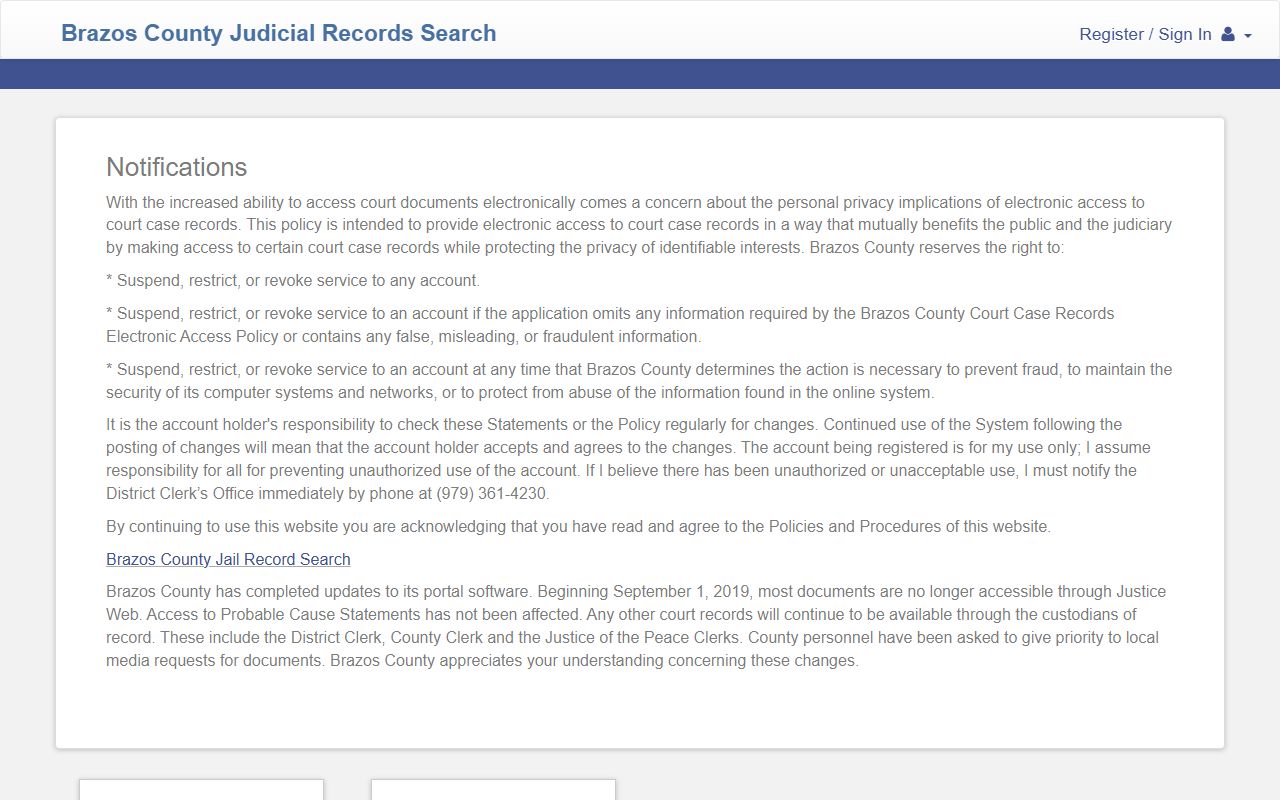
A court record can be absent even when the arrest is real. That usually means the case has not been filed, the search terms need narrowing, or the record is restricted by law.
Brazos County Court Search Fields
The research identifies standard Tyler court portal fields, with a caveat that exact live labels should be screenshot-confirmed. Use the visible options in the portal rather than guessing. A name search works well when the case number is unknown. A case number is stronger when it appears on jail paperwork, bond paperwork, a citation, or a prior court notice.
| Field Label | Type | Required | Notes |
|---|---|---|---|
| Smart Search / Search | Text | Unspecified | May accept name, case number, or party search terms. |
| Case Number | Text | Unspecified | Best when known from court or jail paperwork. |
| Party Name | Text | Unspecified | Search defendant name and narrow common names. |
| Case Type / Court | Dropdown | Unspecified | Use visible options only. |
| Date Filed Range | Date fields | Unspecified | Useful once the approximate filing date is known. |
Charges Filed After Brazos County Arrest
A booking charge is the label entered at jail intake. The court charge begins when a charging document is filed. In Texas criminal practice, the common terms include complaint, information, and indictment. Each has a different role, and the same arrest may move from a booking label to a different filed charge as the prosecutor reviews evidence.
| Document | Plain Meaning | Why It Matters |
|---|---|---|
| Complaint | Supports arrest, probable cause, or misdemeanor prosecution. | May appear early in the arrest-to-court process. |
| Information | Prosecutor-filed formal charge, often used in misdemeanor and some felony contexts when allowed. | Shows the charge the prosecutor chose to file. |
| Indictment | Grand-jury charging document, especially important in felony prosecution. | May replace or refine the initial booking allegation. |
| Jail charge | Arrest or intake label entered during booking. | Useful for custody search, but not always the final filed charge. |
Brazos County Charge Status Terms
Charge status changes as a case moves. A charge may be pending after filing, amended by prosecutor or court action, reduced through plea or screening, dismissed, disposed, or recorded as a conviction. Texas deferred adjudication can also appear in court records and should not be treated the same as every ordinary conviction without reading the case result carefully.
| Status | What It Means |
|---|---|
| Pending | The case is open and unresolved. |
| Amended | The charge language or count changed after filing. |
| Reduced | The current or final charge is lower than the original allegation. |
| Dismissed | The charge or count ended without a conviction on that count. |
| Disposed | The case has a final recorded outcome. |
| Deferred adjudication | A Texas outcome with consequences that depend on completion and later proceedings. |
Bond After a Brazos County Arrest
Bond information begins at booking and magistration, but the court controls legal conditions. Under Texas Code of Criminal Procedure Chapter 17, a bond may be cash, surety, personal, property, no bond, or blocked by a hold or detainer. A person may have a bond amount on one charge and a hold on another, so release requires every charge, warrant, and detainer to be resolved.
| Bond Type | How It Works |
|---|---|
| Cash bond | The full cash amount is deposited with the proper authority. |
| Surety bond | A licensed bail bond company posts the bond after its fee and collateral process. |
| Personal bond / PR bond | Release is based on a signed promise and court conditions instead of upfront full cash. |
| No bond | The person is not releasable on a bond amount at that point. |
| Hold / detainer | Another agency, court, parole authority, or warrant keeps the person from release. |
Brazos County Clerk Record Routes
Court records after a jail arrest may route through different offices. The Brazos County District Clerk is important for district-court filings, while the Brazos County Clerk handles county-level records within its jurisdiction. The District Attorney page helps explain prosecution, but clerks are the normal route for filed case records and certified copies.
The District Clerk page is one official routing source for record questions tied to district court.

Use the portal for search first, then the clerk office when the need is a copy, certification, filing detail, or record that is not visible online.
Warrants and Brazos County Arrest Records
No separate official Brazos County active-warrant public search page was confirmed in the inspected sources. A warrant may still matter in the jail and court record. The roster may show that a person was booked on an arrest warrant, bench warrant, capias, parole warrant, or other hold if the public profile exposes that detail. The court portal may show the underlying case, failure-to-appear event, or warrant-related setting.
| Warrant Type | Relation to Jail and Court Records |
|---|---|
| Arrest warrant | Authorizes arrest and can produce a jail booking once executed. |
| Bench warrant | Issued by a court, often after failure to appear or violation of a court order. |
| Capias | Texas court process that can command arrest after indictment, judgment, or missed court duties. |
| Parole warrant | Can block release even when a local bond appears available. |
| Federal warrant | May involve USMS or federal court and may not appear in a county public list. |
Charges vs Convictions
An arrest and a filed charge are not the same as a conviction. A charge is an allegation being processed through court. A conviction is a final adjudication or plea result allowed by law. The distinction matters for employment, housing, licensing, and personal decisions, and it is also why the footer legal notice bars FCRA-covered use of public-record summaries for regulated screening.
| Point | Charge | Conviction |
|---|---|---|
| Stage | Accusation after arrest or filing. | Final court result after plea, verdict, or adjudication. |
| Can Change | Yes, charges can be amended, reduced, or dismissed. | Changes require court action, appeal, or later legal relief. |
| Custody Link | May appear in jail and court records. | May affect sentence, transfer to TDCJ, or supervision. |
Sealed and Expunged Arrest Records
Texas expunction is governed by Texas Code of Criminal Procedure Chapter 55. Expunction is a court process, not a website removal button. A dismissed, declined, mistaken, or otherwise eligible arrest may require a petition, order, and agency compliance before public systems change. Sealing and expunction also differ, so the result should be read from the court order.
| Point | Sealed | Expunged |
|---|---|---|
| Public visibility | Hidden from many public searches when legally sealed. | Removed or treated under expunction rules after a court order. |
| Agency access | Some government access may remain depending on the order. | Agencies must follow the expunction order. |
| How it happens | Court process under applicable Texas law. | Court process under Chapter 55 when eligible. |
Brazos County Court Record Limits
Texas Government Code Chapter 552 supports public access to government records, but it does not erase every exception. Active law-enforcement records, juvenile matters, victim information, sealed or expunged records, medical information, and records requiring Attorney General review can be withheld or redacted. Statewide conviction history is a separate channel through Texas DPS Crime Records and the official conviction-name search portal.
Important: Court, jail, and search records summarized here are not consumer reports and must not be used for FCRA-covered screening.